A greener approach
to compressed air
Pressure on the food and beverage (F&B) industry to reduce its environmental impact has never been more pronounced. Here, Simon Taylor, Oil-free Sales Manager at CompAir, discusses how owners and operators working in F&B manufacturing and processing facilities can implement greener compressed air strategies.
The Food and Drink Federation, which represents more than 300 companies, has set a net zero commitment for 2040 – ten years ahead of the UK’s national target. Furthermore, the charity WRAP, which aims to create a world where resources are sourced and used sustainably, recently published major new research into the greenhouse gas emissions of the UK’s food system. This showed the equivalent of 35% of total emissions come from production and consumption of the country’s food and drink.
But where does compressed air come into all of this? Compressed air is vital in many F&B production processes. With approximately 10% of all the industrial energy consumed in Europe used to generate compressed air, and with it being used in all kinds of F&B applications, from product filling and conveying, to packaging and moulding – such as for PET bottling – it can play a pivotal part in a more sustainable future.
Switch to oil-free technology
Avoiding process contamination is a necessity for many sites. Fortunately, there are rigorous standards in place, such as ISO 8573, a group of international standards stipulating compressed air purity and quality. These govern compressed air performance and provision in environments, ensuring processes remain free from contaminants, or are at least they are reduced to acceptable levels, while minimising unscheduled downtime and the associated costs, too.
However, it’s important to note that there are no standards or legislation that define an acceptable minimum purity level for compressed air used in F&B manufacture. High-quality air can be achieved by using oil-lubricated compressors, which rely on filtration to protect products and equipment from contamination. However, to guarantee air purity, many are switching to oil-free compressors. The latest models offer new innovations to help ensure they always run efficiently, while being better for the environment too.
Other benefits to oil-free technology include whole life costs being reduced, with businesses able to save on the cost of oil replacement. Unlike oil-lubricated systems that require oil change intervals throughout their service life, there is also no need to purchase equipment that would clean and separate oil from air, such as oil separators, filtration equipment and condensate treatment.
Realise the potential of digital insights
Industry averages suggest energy costs account for more than 80 per cent of the total cost of ownership of a compressor. As such, Industry 4.0 platforms offer a key opportunity to help companies work smarter, reducing energy consumption and the impact on the environment.
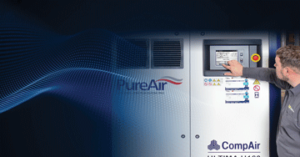
Data analytics can help operators to understand how efficiently a compressor is running, and whether any improvements can be made. These insights will not only help highlight any potential issues now, but also enable operators to forecast any potential future problems too, based on deteriorating machine performance. Predictive maintenance models based on real-time data can then be established to help reduce energy consumption, improve process efficiencies, and mitigate any potential risks.
Implement heat recovery
Heat recovery effectively enables a system to ‘recapture’ energy lost in the compression process and put it to other useful purposes. It can supplement or replace the electricity, gas or oil needed to create hot water for washrooms or process water. Alternatively, it can be transferred as direct warm air into a workspace, warehouse, loading dock or entryway.
Recycling heat not only helps lower energy bills, but it also reduces CO2 emissions too. For F&B manufacturers using compressed air as part of their day-to-day operations, heat recovery can make a real difference.
Heat can either be recovered via an air-cooled system or a water-cooled one. Air-cooled compressors typically produce a high hot air flow rate at a low temperature, and so might be used for space heating or heat exchanging to a preheating battery. With this approach, an energy recovery unit is fitted to the compressor’s oil circulation system, recirculating warm air from the compressor to a local area. For heat recovery to be most effective with an air-cooled compressor, it is recommended that a business has relatively consistent heating demands. In this way, the available energy is always utilised when the compressor is running.
Alternatively, there’s water-cooled compressors. Water-cooled compressors are generally either ‘open’ systems that do not circulate water, and are connected to an external water supply, or do circulate water, and are connected to a water tower. The third option is a ‘closed’ system with circulating water, that benefits from an external heat exchanger.
The real opportunity for water-cooled systems lies with using recovered energy to heat water supplies in manufacturing processes, for applications such as central heating, hot water washing and steam systems. High degrees of efficiency can be achieved from water-cooled installations that are directly connected to a continuous process heating requirement. For instance, with oil-free screw compressors, heat appears at the low-pressure and high-pressure compression elements, the oil cooler, intercooler and aftercooler. By tapping into the energy potential of all these components, it is possible to generate recycled hot water of up to 85oC.
By adopting measures such as these, the F&B sector can move closer to its environmental commitments and targets.
To find out more about how sites can make their compressed air operations more environmentally friendly, CompAir has published a new white paper on the topic. To download it for free, please visit https://www.compair.com/en-gb/industries-and-applications/food-and-beverage

About CompAir
With over 200 years of engineering excellence, CompAir offers an extensive range of reliable, energy efficient compressors, dryers and accessories to suit all applications. An extensive network of dedicated CompAir sales companies and distributors around the world provide global expertise with a truly local service, ensuring CompAir’s advanced compressor technology is backed up with the right support. CompAir has consistently been at the forefront of the compressed air market, developing some of the most energy efficient and sustainable compressors available today, helping customers to achieve or surpass their environmental targets.