


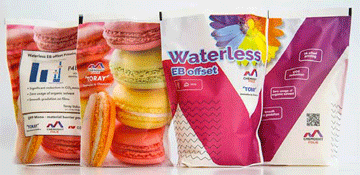
The result of this cooperation will be a one-of-a-kind flexible film printed by waterless EB offset which could be used in different packaging solutions. As the first example, Chemosvit and Toray today revealed a new mono-material pouch sample with a barrier function, which not only reduces CO2 emissions but also contributes to the circular economy.
Offset printing technology in flexible packaging is still not as widely used as gravure and flexographic printing, but is beneficial especially in short and medium runs as it has a shorter
time to market and offers more flexibility for production, as offset plate can be imaged within minutes. Recently these advantages have been getting more important as food and consumable products are shifting to a broader variety of goods in smaller quantities.Toray and Chemosvit believe waterless EB offset printing is the most environmentally sustainable solution. This
technology is working without solvents. According to Toray’s estimation, its CO2 emissions are more than 80% below those from gravure printing. On top of it, it enables a 100% VOCfree process. Furthermore, as offset plates are made of aluminum, they can be recycled. In the end, the total energy consumption is much less than in other printing technologies. Chemosvit believes waterless EB offset printing will provide insight into optimizing the film properties to achieve the best printing results. Through this cooperation both companies are working on fine-tuning the new printing technology.
For printing, a water-washable ink for which Toray has developed novel material will be used. Major ink manufacturers are currently working on its development and commercialization.
Innovations in Food (& Beverage) Processing & Packaging is a quarterly magazine distributed globally both in Print and Digital formats. www.innovationsfood.com. Twitter: @Innovfoodtech. Instagram: @innovationsinfoodtechnology. Linkedin: www.linkedin.com/in/terry-prior52


