Sports nutrition meets power microalga –
Natural astaxanthin for strength,
endurance and recovery
Benefits of natural astaxanthin for Muscle Performance
- Boosts muscle endurance and recovery
- Lowers lactic acid and fatigue
- Reduces muscle damage and inflammation
- Protects mitochondria and enhances fat metabolism by improving mitochondrial functions
The natural antioxidant derived from the microalga Haematococcus pluvialis protects the mitochondria’s membranes from oxidation, thus enhancing mitochondrial function and reducing inflammation. The carotenoid also increases muscle endurance and lowers lactic acid build-up.
An active lifestyle is fundamental to good health. So perhaps not surprisingly, increasing awareness of the advantages of a holistic approach to physical and mental wellbeing means that supplements are in the spotlight like never before.
Natural astaxanthin offers a number of benefits for athletes and, is easily integrated into sports nutrition. Staying and getting in shape is prompting more and more consumers to exercise and make informed dietary choices, therefore driving demand for end products that contribute to health and agility.[1]
Backed by science
Natural astaxanthin from the microalga Haematococcus pluvialis is one of the most powerful antioxidants known to science. The AstaReal Group is a pioneer in the cultivation and research of this algae, from which the valuable antioxidant is derived. Furthermore, AstaReal® is the most studied brand of natural astaxanthin, with a constantly growing portfolio of human clinical trials in different health areas. Study results show that the nutrient can boost muscle power, support endurance and reduce lactic acid build-up, making natural astaxanthin an important ingredient for sports nutrition and dietary supplements.

Soothing sore muscles
Both during and after physical activity, muscles are subjected to high levels of inflammation because of increased levels of free radicals. This is as a result of muscle fibre stress and elevated metabolism. Oxidative stress also promotes inflammation by activating pro-inflammatory cytokines, which in turn leads to muscle pain, stiffness and a higher risk of injury. By damaging mitochondrial membranes, oxidative stress impairs the body’s energy production process too. As the cell’s powerhouses, these organelles are responsible for 95% of the body’s energy. If mitochondrial function is restricted, the muscles receive less energy which can contribute to fatigue and muscle atrophy. Moreover, oxidative processes can reduce the motility of red blood cells, leading to decreased blood flow and less oxygen reaching the muscles. This, and impaired mitochondrial function, can decrease an athlete’s aerobic capacity, leading to more lactic acid generation and faster fatigue onset. However, the results of a placebo-controlled, double-blind study conducted among football players concluded that daily supplementation of 4mg AstaReal® natural astaxanthin for 90 days combined with physical training significantly decreased the expression of the pro-inflammatory marker CRP (C-reactive protein). Furthermore, the severity of muscle damage was significantly reduced[2].

Reduction in free radical damage
Mitochondria are the primary source of cellular energy production. The fuel driving our body (i.e. adenosine triphosphate [ATP]) is made in the folds of the inner membrane of the mitochondrion. As the inner mitochondrial membrane has numerous folds, the surface area for the generation of ATP is large enough to meet the energy needs of active organs like brain and the muscles. Muscular contractions stimulate reactive oxygen species production in active muscle fibres and skeletal muscles are a primary source of free radicals. Aged or damaged mitochondria produce excess free radicals too, which can reduce the supply of ATP and contribute to energy loss and mitochondrial dysfunction. Natural astaxanthin protects cell and mitochon-drial membranes from oxidation. As natural astaxanthin forms trans-membrane bridges, it can help to control free radicals in the membranes and therefore help to maintain mitochondrial functionality. The combination of its potency and its chemical structure being aligned to that of the membranes makes it a perfect mitochondrial nutrient.
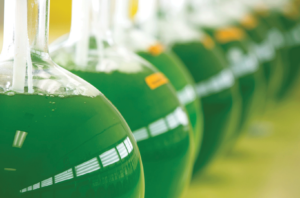
© AstaReal (Haematococcus pluvialis algae)
Less lactic acid
Natural astaxanthin reduces lactic acid build-up too, as shown in a study with runners.[3] This acid develops during anaerobic respiration, when the muscles are undersupplied with oxygen. This, in turn, causes muscle fatigue and a burning feeling during exercise. During the study, the runners took 6mg of astaxanthin per day for 4 weeks. After that, lactate levels were analysed before and 2 minutes after a 1200-metre run. The results revealed that after running, the supplemented athletes had a significantly lower lactate level compared with the placebo group. By supporting aerobic respiration in the mitochondria, astaxanthin is able to reduce lactate formation and improve endurance.
Faster and stronger
Astaxanthin has also been shown to improve muscle performance.[4] A further study investigated the antioxidant’s efficacy on cyclists who performed a 20km cycling test after a two-hour ride. Compared to the placebo group, the cyclists treated with 4mg of AstaReal® astaxanthin were able to ride 121 seconds faster after the supplementation period. A notable increase (15%) in power output in the astaxanthin group was also recorded. Another placebo-controlled double-blind study examined the endurance, fitness and power of 40 healthy men in standard exercise tests.[5] Twenty men received 4mg astaxanthin per day for a period of 6 months. The astaxanthin group was able to complete more knee bends than those who took a placebo, and improved their performance by 38% compared with baseline. Thus, the scientists concluded that astaxanthin is able to improve power and endurance. Since natural astaxanthin plays a vital role in supporting muscle endurance, strength and mobility, it helps fighting the effects of debilitating conditions such as sarcopenia. Findings from a randomised, double-blind placebo-controlled study on 58 adults aged 65-85 years indicate that the AstaReal® astaxanthin formulation in combination with functionally based exercise training improves endurance and walking distance, as well as elevates muscle strength and size (sarcopenia suppression) in older age.[6]
Natural vs. synthetic
Artificial (non-natural) versions of astaxanthin are produced by chemical synthesis from petrochemicals. There are important molecular differences between natural and synthetic astaxanthin. Over 95% of the natural astaxanthin molecules are esterified, which means that one or two fatty acids are attached to the ends of the molecule. Natural astaxanthin is able to span across the entire membrane and provide protection in a way that the synthetic version cannot. Synthetic astaxanthin is completely unesterified and poorly absorbed by the body. The pharmaceutical, cosmetic and food industries prefer natural astaxanthin because of its potentially higher bioavailability, proven safety, and more biological functions. The natural astaxanthin market benefits from the increasing awareness about health benefits and fewer adverse effects over synthetic astaxanthin.

Question of quality
Algae have adapted and evolved over thousands of years in order to protect and sustain themselves during ever-changing environmental conditions. Unique biosynthesis gives algae an abundance of nutrients and specialized bioactive compounds. However, the astaxanthin’s quality is affected by the environment the microalgae are cultivated in. As the market is growing, there is unfortunately an emergence of some poorer quality products. Therefore, when choosing an astaxanthin supplier, companies should — among other things — pay attention to their production methods, the stability and purity of their products, the astaxanthin content in the biomass and their quality certifications.
AstaReal pioneered the development of natural astaxanthin as a nutritional ingredient and, in the early 1990s, became the first company in the world to commercially produce natural astaxanthin from microalgae. Its cultivation process features the tightest controls in the industry and yields an ingredient with notably high purity, stability and potency. AstaReal rejected the open pond and other outdoor production methods as they are susceptible to contamination. The company cultivates and processes its algae indoors under controlled conditions in specially designed photobioreactors. This results in a safe product with a minimum yield of 5% astaxanthin in the biomass and without solvent residues or other impurities.
Rising demand for natural astaxanthin
Conventional algae are steadily gaining in popularity among consumers. This trend offers enormous potential for the market growth of microalgae products; especially astaxanthin, one of the most popular algae ingredients. Driven by consumer demands for health and wellness products, astaxanthin is experiencing huge growth in the European market as well as in Asia. A report published by Research and Markets in 2017 forecasted that the global market for natural and synthetic astaxanthin would grow at a CAGR of approximately 8% from 2017, to reach more than $800 million by 2022[7]. In 2020, the global astaxanthin market size was already estimated at $1,371.24 million[8]. Naturally produced astaxanthin market segment dominated the market in 2020 in terms of revenue and is estimated to witness high CAGR of 19.3% until 2028. It is estimated that the global market for Haematococcus pluvialis will grow at an average annual rate of 13.6% between 2020 and 2027, mainly due to the numerous health benefits of astaxanthin, rising health awareness and increasing consumption of antioxidants in food and supplements. Microalgae, such as Haematococcus pluvialis, have been widely used by many manufacturers owing to high amount of carotenoid content and easier methods of extraction. Demand continues unabated, as consumers are looking for preventive, natural substances to support their health now more than ever.

Star of sports supplements
Although health benefits of astaxanthin is proven in a range of categories, the sports nutrition market is a key area of interest. The ingredient’s application potential to aid performance and recovery – pre-, during and after workout – appears to be almost unlimited, whether taken in the form of easy-to-swallow capsules, functional drinks or convenient sachets. Based on the growing body of evidence supporting its benefits, astaxanthin is on course to become an unrivalled ingredient in sports nutrition products.
References:
1 Innova Market Insights (2020): Top Ten Trends for 2021. https://www.innova marketinsights.com/press-release/innova-identifies-top-10-food-and-beverage-trends-to-accelerate-innovation-in-2021/ Last accessed: 02/02/2021
2 Baralic et al. Effect of Astaxanthin Supplementation on Salivary IgA, Oxidative Stress, and Inflammation in Young Soccer Players. Evidence-Based Complementary and Alternative Medicine, vol. 2015, Article ID 783761, 9 pages, 2015.
3 K. Sawaki, et al., “Sports Performance Benefits from Taking Natural Astaxanthin Characterized by Visual Acuity and Muscular Fatigue Improvements in Humans,” Japanese Journal of Clinical Ophthalmology 18(9), 1085–1100 (2002).
4 Earnest C.P. et al.: Effect of astaxanthin on cycling time trial performance. Int J Sports Med. 32(11):882-8 (2011).
5 Curt L. Malmsten, et al. Dietary Supplementation with Astaxanthin-Rich Algal Meal Improves Strength Endurance – A Double Blind Placebo Controlled Study on Male Students. Carotenoid Science, 13, 20-22 (2008).
6 Liu SZ et al.: Building strength, endurance, and mobility using an astaxanthin formulation with functional training in elderly. Journal of Cachexia, Sarcopenia and Muscle. Sep 2018, 10.1002/jcsm.12318.
7 Research and Markets report: “Astaxanthin Market by Source, Form, Method of Production, Application, and Region – Global Forecast to 2022”, May 2017.
8 Grand View Research, ‘Astaxanthin: Market Analysis & Market Forecast from 2017-2028’.
For more information, please contact us:

AstaReal AB
Forumvägen 14, Level 16
131 53 Nacka, Sweden
info@astareal.se
+46 (0) 8 5701 3950