Biotics
The new must-haves for immunity
Over the past few years, the immunity supplements market has been rising. Indeed, aging processes, unbalanced diets, stress, and other lifestyle habits can impact the effectiveness of our immune system.
Two years after the COVID-19 pandemic began, consumers have shown an even stronger interest in reinforcing their immune health. A great example of this rising concern came in 2021 as product launches with immune health claims[1] increased by 20%. Nevertheless, this growth followed an 8% compound annual growth rate (CAGR) between 2017 and 2019, making the dietary supplement market before the pandemic more structured.
Sometimes, our immune system may fail, but it is possible to intervene in this process. Eating enough nutrients as part of a varied diet and living a healthy lifestyle are required for the health and function of all cells, including immune cells. Each stage of the body’s immune response relies on the presence of many micronutrients. These nutrients help the immune system in several ways: working as an antioxidant to protect healthy cells, supporting the growth and activity of immune cells, and producing antibodies.
Ingredients like vitamins D, C, and B and minerals such as zinc have proven themselves in immune choices. Still, customers desire to access innovative ingredients with clinical evidence and demonstrated efficacy. Indeed, considering the complexity of our immune system, it’s important to think outside the box weighing innovative ingredients to enhance immune health.
Enter the biotics! The gut microbiome significantly impacts one’s health, and scientists are just now beginning to understand all its complexities. Decades of research have shown that the microbiome can be modulated with many distinct types of biotics.
Dietary components may help or hinder the development of certain microorganisms and contribute to the overall composition of one’s gut microbial genetic pool. This may be accomplished via a change of diet (rich in plant carbohydrates and fibers) but also using dietary supplementation. In that sense, two major components may play a role in the gut’s microbial diversity: probiotics and prebiotics.
Probiotics: the Obvious Ingredient for Immunity
Probiotics occupy an important place in the competitive market of ingredients dedicated to immunity. Indeed, probiotics are now perceived as an obvious solution for consumers. In the USA, more than 80% of Americans know that probiotics may positively affect their immune health.
This change of mindset about probiotics explains the critical interest in probiotics as ingredients for immunity. According to a 2020 survey from the Council for Responsible Nutrition (CRN), probiotics are in the top five ingredients dedicated to immunity. In 2022, US consumers showed a higher interest in probiotics; they are now among the greatest of this market, even more important than zinc[2].
This interest in probiotics is not about to wane. To meet the growing demand for ingredients dedicated to immunity, the long-term growth of probiotics is expected at a CAGR of 9% worldwide from 2021 to 20283. LifeinU® BSCU1 meets consumer needs Gnosis by Lesaffre offers consumers LifeinU® BSCU1, a unique probiotic dedicated to immune health. LifeinU® BSCU1 is a specific strain of Bacillus subtilis, a common and safe bacterium registered in the CNCM collection under the number I-2745. LifeinU® BSCU1 is stable for 24 months with no CFU decrease making it ideal for long-shelf applications. Moreover, this probiotic is strong enough to resist industrial processes enabling it to be incorporated into functional foods. A clinical study validates the efficacy of this probiotic on immunity.
Before going deeper in the clinical, let’s get back to the basics of immunity. Antibodies called immunoglobulin drive an essential part of immune health. An antibody is a protein secreted by the immune system in response to the presence of a pathogen substance, the antigens. Antibodies will detect antigens and destroy them through the macrophages.
One of the most critical antibodies of the immune system is the secretory immunoglobulin A (sIgA). This antibody is located at the most vulnerable interface with the environment: the mucosa. The mucosal surfaces, such as the linings of the respiratory and gastrointestinal tracts, represent an enormous area of potential exposure to pathogens. The sIgA as an antibody can catch toxins and infectious agents and inhibit the interaction with the respiratory and intestinal epithelium. Thanks to the effect of sIgA on pathogens, we can consider them the body’s first line of defense.
Some factors influence the level of sIgA in the human body. The first one is age; indeed as we age, the level of sIgA decreases. Some other external factors can lead to a decrease of the sIgA concentration. The most important is intensive training, but other like long-term use of medication or even our modern lifestyle can leave us stressed, fatigued, and sleep deprived. All these different factors directly impact our immune system, inducing the weakening of our natural defenses. Consumers are now aware that to perform well every day, they must maintain a healthy and powerful immune system, that means keeping a high level of sIgA.
Efficacy validated by clinical study
To investigate the immunity benefits of LifeinU® BSCU1, Gnosis by Lesaffre initiated a clinical trial. This clinical study was performed according to gold standard method: double-blind, randomized, and placebo-controlled. This study was also conducted in collaboration with an independent expert in Gastroenterology and Immunology: Professor Philippe Marteau from Paris 7 university and AP-HP, Hôpital Saint Antoine, Paris France.
The clinical study was performed for 4 months, with supplementation every first 10 days of each month. The 100 volunteers, with an history of common infections, were split in two groups: 50 supplemented in LifeinU® BSCU1 and 50 with placebo.
At the end of the study, the level of sIgA of the group supplemented in LifeinU® BSCU1 was higher compared to the placebo group. Indeed, the level of sIgA in the saliva was 45% higher compared to the placebo. The level of sIgA was also higher in the intestine with an increase by 65% after 10 days of consumption and by 87% increased at the end of the study[4].
“LifeinU® creates a double-protective effect by significantly increasing durable sIgA levels in the intestine and saliva” says Antoine Vanhove, product manager.
Further, this clinical study was conducted to investigate symptoms, something that is very important for consumers. A supplementation with LifeinU® BSCU1 is associated with the reduction in the frequency of upper respiratory tract infections by 45%4. “The protective effect of LifeinU® BSCU1 is confirmed by a significant reduction in the incidence of upper respiratory tract infections” continues Vanhove. Moreover, in the group supplemented with LifeinU® BSCU1, researchers observed a reduction of the average number of days of infectious episodes by 38%4, 2.8 days less compared to the placebo group. This reduction concerns also the percentage of people that experience one or more infectious episodes by 31%4.
Thanks to these results, we can say that LifeinU® reduces the risk of common infectious episodes.
An innovative scientific probiotic
At Gnosis by Lesaffre, we want to develop innovative solutions to answer customers’ needs. These solutions gravitate around the product. One of the latest innovations developed by Gnosis by Lesaffre is a new in-vitro model to investigate again on LifeinU® BSCU1 benefits.
With this new in-vitro model, we want to be a pioneer in innovation and new scientific models. For that, we are inventing the science of tomorrow by developing new models that allow us to innovate better and faster, adapting models that can used for different ingredients. We also want to adapt our science to be more sustainable, avoiding the use of animal models. Our new models mimic as close as possible human model in the preclinical stage to anticipate the results we may observe during the clinical trials.
The new model developed is called the intestine-chip. Created by Emulate, it is a 3D human-printed model. Some cells from the intestine are collected and cultivated to get the intestine cell organization to recreate a cellular microenvironment like the human one. The top part is the lumen of the intestine with the epithelial cells, the bottom part is composed of endothelial cells that mimic blood circulation. With this organization, the environment is dynamic because some flow can be implemented in the top or bottom channels. The innovation handled by Gnosis by Lesaffre was to implement immune cells on the endothelial channel.
A supplementation with LifeinU® BSCU1 in this model highlights an increased concentration of the sIgA, in correlation with the results observed during the clinical trial. These results confirm once again the positive impact of LifeinU® BSCU1 on sIgA concentration and immune health.

A probiotic that supports immune health
As most experts in the field reasonably substantiate the LifeinU® BSCU1 scientific basis, LifeinU® BSCU1 is eligible for several claims in the US market.
We can say that:
– LifeinU® BSCU1 supports immune health
– LifeinU® BSCU1 helps stimulate the production of sIgA, an important immune biomarker
– LifeinU® BSCU1 supports immune health by stimulating the production of sIgA, an essential immune biomarker
For other countries where it is challenging to attach claims to probiotics, Gnosis by Lesaffre offers some solutions. LifeinU® BSCU1 is suitable for blending with ingredients with claims on
immunity, such as zinc or B vitamins. Gnosis by Lesaffre offers Lynside® Forte Zn, a zinc-fortified yeast eligible for European immunity claims. Another possibility to be blended with our
probiotic is the Lynside® Forte B100 EU, a B vitamin-fortified yeast eligible for European immunity claims thanks to its content of vitamins B6, B9, and B12. Capitalizing on the awareness of other ingredients recognized for their immunity benefits may be an option to utilize an immunity claim with probiotics.
A great way to get the best from probiotics is to feed them with prebiotics. As with any other living organism, probiotics need energy to function properly!
Besides, prebiotics improve our microbiota diversity through the modulation of its composition, providing numerous health benefits.
Prebiotics: How to improve immunity through the enhancement of our microbiota diversity?
A rising notoriety for immunity
More than ever, prebiotics are gaining popularity when it comes to immune ingredients. Supplement launches with prebiotic ingredients exploded between 2017 and 2021 with a 25% of CAGR. Accordingly, the global market of prebiotic-based products is projected to double in 10 years, reaching €15 billion in 2030 with a CAGR of 8%.
Among the existing products, around 1,500 prebiotic-based products were launched in 2021, with 40% positioned in the “immune health” subcategory. Those supplements are mainly under powder forms, caps, or gummies for multiple uses according to the preferences of consumers[5].
Regarding consumer awareness, an average of 65% of people from North America, Europe, Asia, and South America admitted that prebiotic consumption matters when it comes to immunity.
The role of prebiotics on the microbiome
Prebiotics are mainly carbohydrate compounds that can be found in food, mainly fruits, vegetables, whole grains, and yeasts. They are selectively fermented by bacteria (like probiotics) within the gut microbiota, stimulating their health benefits.
This fermentation allows bacteria to not only thrive but also to produce short-chain fatty acids (SCFA) as part of their metabolic activities. Among those metabolites, butyrate and propionate, for example, are known to be involved in the proliferation and differentiation of immune cells. Acetate on its side regulates the pH of the gut to protect against pathogenic bacteria.
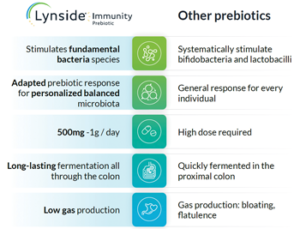
So far, well-known prebiotics in the market include Inulin, Galacto-oligosaccharadies (GOS), and Fructo-Oligosaccharides (FOS). They are known to be effective with several daily grams, which can cause bloating and flatulence. Another fact about historical prebiotics is that they stimulate the same families of bacteria, mainly lactobacilli and bifidobacteria.
But knowing that our gut contains thousands of billions of microorganisms classified in around 100 to 400 families, why would we restrict to only two or three prebiotics?
Answering the needs for bacteria diversity
Beyond this broad bacteria population, we all share a common structure in our microbiota composition. Yet everyone displays their own microbiota signature, and similar compositions can be gathered in three main microbiota profiles: the enterotypes.
Each enterotype is relatively linked to geographical areas and thus to lifestyle and food consumption habits. The enterotypes are identified by the presence of members from one or another bacteria family and by specific metabolic activity.
Since the metabolic activities are selective, and because everyone belongs to a different enterotype, it is important to offer a wide spectrum of prebiotics to achieve microbiome diversity.
A loss of diversity is generally accepted to have taken place through ages and societal changes. Less fermented food, less whole grain, and increased food preservation are potential factors that may have progressively decreased the richness of the human microbiota[]6.
Nutrition intervention is a means to play on the microbiome diversity. This may be accomplished via a change of diet (rich in plant carbohydrates and fibers), but also using food supplementation. Providing personalized micronutrition is a great way to encourage each bacterial family to thrive in its own unique microbiota environment.
Lynside® immunity prebiotic: One single product for personalized micronutrition
In that scope, Gnosis by Lesaffre launched Lynside® Immunity Prebiotic as the first patented yeast-based prebiotic. Its complex structure is degraded only by a few fundamental bacteria species not usually targeted by other prebiotics[7].
A dynamic in-vitro gut model study shows a long-lasting fermentation of Lynside® Immunity Prebiotic in proximal and distal colons. The results showed that Lynside® Immunity Prebiotic induces both an adapted metabolic activity and a modulation of the microbiota composition, depending on the host enterotype. Further, combined with a very low daily dosage requirement, this scenario promotes a continuing prebiotic response with low gas production, challenging the current prebiotic side effects.
The results showed that Lynside® Immunity Prebiotic induces both an adapted metabolic activity and a modulation of the microbiota composition, depending on the host enterotype. Lynside® Immunity Prebiotic offers untapped opportunities for personalized and adapted micronutrition to design new products dedicated to immune health!
A relevant and innovative in-vitro approach
The potential prebiotic effect of Lynside® Immunity Prebiotic has been evaluated on the microbiota of human volunteers selected for their health status but also based on their fecal microbiome pattern associated with two different enterotypes, i.e., Ruminococcus and Prevotella.
This innovative study was conducted in partnership with ETH Food Biotechnology’s lab (Zurich, Switzerland). Samples from two different enterotypes donors representative of the population were tested in the in-vitro gut model PolyfermS® (Polyfermentor Intestinal Model) with Lynside® Immunity Prebiotic, in low and high dosages.
The microbiota composition modulation was assessed to identify the potential bacterial groups impacted and responsible for SCFA pattern modification. Prevotellaceae family: according to the SCFA production pattern, propionate producers were affected by the ingredient, with a shift observed in the relative abundance inside. This selective promotion effect on some bacteria from this Prevotellaceae family is in accordance with their enzymatic competitive ability to degrade complex carbohydrates. Therefore, it gives them competitive access to the degradation of the specific yeast β-glucan harbored in Lynside® Immunity Prebiotic.
A biotic universe seeking combinations to raise immunity to the next level
Some changes are observed in the biotic universe. In the past, most biotics were found in standalone products. Even if sometimes it was possible to find a blend of some strains of probiotics, most of the products contained only one type of biotic. As the world is changing, biotics are also impacted by this evolution. Indeed, brand owners are now interested in blending different biotics to combine benefits.
Gnosis by Lesaffre ingredients are in line with this evolution of the market. Indeed, a blend of LifeinU® BSCU1 and Lynside® Immunity Prebiotic can get a double-positive effect on immunity. This biotics blend combines both effects on immunity of LifeinU® BSCU1 and Lynside® Immunity Prebiotic. On the one hand, LifeinU® BSCU1 supports immunity by increasing significantly durable sIgA levels. At the same time, Lynside® Immunity Prebiotic plays on the microbiome diversity to promote the production of immune-supportive SCFA.
The biotic world offers an infinite number of possibilities that are barely explored. Probiotics, prebiotics, postbiotics, symbiotics… the possible combinations are endless, which makes the future full of opportunities for these ingredients.
Sources:
- Innova database
- Unlocking Insights into the Supplement Consumer: 2022 Trends and Opportunities – Market Place
- Probiotics Market by Ingredient, Function, Application, and End User: Global Opportunity Analysis and Industry Forecast 2021-2030
- Lefevre M, et al. Probiotic strain LifeinU™ BSCU1 stimulates immune system of elderly during common infectious disease period: a randomized, double-blind placebo-controlled study. Immune Ageing. 2015 Dec 3;12:24. Doi: 10.1186/s12979-015-0051-y.
- Prebiotic Ingredients Market – Global Forecast to 2023 – Markets and Markets 2017
- Sonnenburg E.D. et al. Starving our Microbial Self: The Deleterious Consequences of a Diet Deficient in Microbiota-Accessible Carbohydrates. Cell Metabolism. 2014.
- Rodriguez B. A yeast product, and a composition comprising it, for use as a prebiotic agent. Patent WO2020152229. 2020.
Author and company description:
At Gnosis by Lesaffre, we explore life to improve living, and it is our mission to provide scientifically proven and sustainably sourced active ingredients to enhance wellness and health for consumers at all stages of life. Clarisse GERACI and Antoine VANHOVE are product managers at Gnosis by Lesaffre, in charge of the Wellness & Immune Health market, such as vitamins and mineral yeast, probiotics, and prebiotics.