


How dairy and beverage plants can design boiler systems around variable loads, sanitation demands, and uninterrupted process heat
By: Nathan Munger, Business Development Executive for Food & Beverage at Miura
Steam enters dairy and beverage production at moments when the process has little tolerance for drift. It heats product to validated pasteurization conditions, supports cooking and hot fill, and brings cleaning solutions to temperature during clean in place cycles. A pressure dip can become a temperature deviation and boiler outage can interrupt sanitation, delay production, or put a batch at risk. Yet the plant that needs full steam capacity during an early morning startup may require only a fraction of that output a few hours later.
Reliable design begins with this changing demand. Engineers must understand the plant’s actual load profile, determine how quickly the system needs to respond, and provide enough redundancy to protect critical production without keeping excessive capacity online when it is not needed.
Maintain Steam Pressure to Protect Product Quality and Process Control
Steam reliability should be evaluated where pressure and heat affect the product. In a saturated steam system, temperature follows pressure, so an unstable header can produce inconsistent heat transfer at pasteurizers, heat exchangers, kettles, tunnels, and sanitation equipment.
Pasteurization makes the consequence easy to see. The process must hold the product at a specified temperature for the required time. A pressure drop can slow heat transfer or pull the process outside its validated operating window. Depending on the deviation, the plant may need to hold the product for review, repeat part of the process, or discard the batch. Similar instability can extend cooking time, disrupt hot-fill conditions, or produce uneven results between runs.
Clean-in-place, or CIP, cycles create another direct link between boiler performance and production readiness. Cleaning solutions must reach and maintain target temperatures as they move through tanks, piping, and process equipment. When steam cannot support that demand, the cycle may take longer or need to be repeated before the line returns to service. Steam therefore supports food safety, product consistency, sanitation, and the schedule connecting one production run to the next.
Account for Startup Peaks, Load Swings, and Sanitation Demand
A food plant’s steam demand rarely resembles the steady load used in a simple nameplate calculation. It rises and falls with startup, product mix, line sequencing, changeovers, and sanitation. The useful question is how much steam the plant consumes, when it consumes it, and how quickly that requirement changes.
Consider a facility starting after a weekend shutdown. Heat tunnels and process water may need to come to temperature while batching begins, creating a sharp early demand. Once production settles into a steady run, the load might fall to 20 or 30 percent of that peak. A product changeover can drive demand close to zero, followed by a short CIP cycle that sends it upward again. Co-manufacturers add further variation as they move between pasteurized and nonpasteurized products or hot-fill and cold-fill lines. This pattern looks less like a flat line and more like a pulse. Controls must respond when header pressure falls, then reduce firing as demand recedes. Slow response creates pressure sag at the process. Limited turndown leaves a large boiler cycling or remaining hot during low load periods.
Sizing around a single maximum can also create an expensive compromise. One large boiler may cover the peak but expose the plant to a single equipment failure. A second full-size unit provides backup, yet can leave far more capacity installed than the facility normally uses. A stronger load study maps the magnitude, duration, and timing of each demand, including which processes can occur simultaneously. For facilities evaluating an upgrade, a current-boiler efficiency assessment can also help quantify how existing equipment performs across the operating range and identify opportunities to better align capacity with actual production demand. Miura offers customers a full load analysis and current-boiler efficiency study as part of this evaluation.
Size Modular Boiler Capacity for Part Load Efficiency and N+1 Redundancy
A sound configuration must cover the highest credible demand without losing efficiency or control at the bottom of the load range. That balance changes how engineers should approach both capacity and redundancy. N+1 redundancy means the plant can meet its defined operating requirement with one unit unavailable. Defining that requirement is crucial. Some facilities need full production during maintenance. Others need enough steam to protect product, complete sanitation, and keep priority lines operating until the unavailable unit returns. Redundancy should be measured against that critical load rather than assumed to require a duplicate of the largest possible peak.
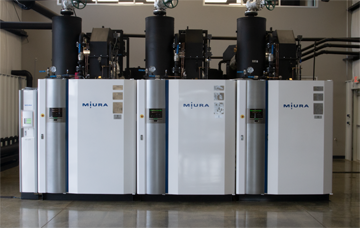
Multiple smaller boilers can make capacity easier to shape. A plant requiring 900 boiler horsepower at peak, for example, might use four 300-horsepower units. With one offline, the remaining three can still provide 900 horsepower. A conventional two-boiler arrangement could require two 1,000-horsepower units to preserve similar backup capacity, leaving considerably more equipment installed and hot.
Modularity also improves part-load control. As demand falls, the system can shut down complete units and leave fewer boilers operating within an efficient firing range. When demand returns, fast-starting or standby units can rejoin the header before process pressure drifts too far. Engineers should verify cold start time, standby response, pressure control range, and behavior after an abrupt load reduction. Supporting equipment deserves the same scrutiny because distributed feedwater pumps and other auxiliaries can prevent one ancillary failure from disabling the entire system.
Use Water Treatment and Condition Monitoring to Prevent Unplanned Downtime
Rapid response addresses immediate load changes. Water quality, scale formation, and rising tube temperatures develop more slowly, but they can be just as damaging to reliability. Boiler feedwater requires softening to remove hardness that can form scale on heat transfer surfaces. Even a thin deposit impedes heat flow, forcing metal temperatures upward and reducing efficiency. Left uncorrected, scale can contribute to tube damage and an unplanned shutdown. A strong treatment program combines suitable equipment and chemistry with routine testing, clear operating limits, and prompt investigation when results drift.
Miura America applies this broader approach through compact once through watertube boilers, integrated water treatment equipment, and its Miura Connect remote monitoring platform. Miura’s modular boilers can reach 150 psig from a cold start in about five minutes, while a unit held in standby can begin producing steam in seconds. Controls monitor header pressure, bring additional boilers online as demand rises, and back them off as pressure recovers.
The connected system can also alert personnel when water hardness or tube temperature indicates a developing problem. Notifications can arrive by text or email, while multi-site operators can view a green, yellow, and red status display across several facilities. This supports a predict and prevent maintenance strategy: identify the condition, investigate its cause, and service one boiler while the remaining modules continue supplying the plant. The compact once through design also limits the water volume and stored energy within each unit, an important consideration in boiler room safety.
Design Boiler Room Capacity for Future Production Changes
A dairy or bottling facility seldom follows the same production plan for the full life of its boiler system. New products alter heating requirements, additional lines raise peak demand, and a shift toward cold-filled products may reduce the amount of steam required. Sanitation practices, operating hours, and energy goals continue to evolve as well.
Miura’s modular design gives the steam plant a practical way to follow those changes. Rather than relying on one or two large boilers, the system distributes capacity across multiple compact once-through units that can be staged according to actual production demand. Individual boilers come online as the load rises and shut down or remain in standby as it falls. This arrangement can also provide N+1 redundancy without requiring a full-size duplicate of the plant’s peak capacity, allowing one unit to be serviced while the remaining boilers continue supporting critical operations.
The same modular structure gives facilities more flexibility over time. Capacity can be added in smaller increments as production expands, while units removed from a reduced operation can potentially be reassigned elsewhere. The compact footprint can also preserve boiler room space for future growth, although designers still need to account for fuel supply, feedwater capacity, venting, controls, and service access across the completed system.
That flexibility is most valuable when it rests on a disciplined understanding of the process. A reliable steam plant follows the real production curve, responds before pressure loss reaches the line, and keeps critical capacity available during maintenance. Water treatment and connected monitoring help identify developing conditions before they become outages. Together, these capabilities allow the boiler room to support the plant’s current schedule without limiting its next product, production line, or operating priority.
Innovations in Food (& Beverage) Processing & Packaging is a bi-monthly magazine distributed globally in Digital format. www.innovationsfood.com. X: @Innovfoodtech. Instagram: @innovationsinfoodtechnology. Linkedin: www.linkedin.com/in/terry-prior52


