




Alland & Robert announces that acacia gum has growth
opportunities, following the decision of the American Food &
Drug Administration (FDA) to recognize the dietary fiber status
of acacia gum
International leader in natural gumsAlland & Robert is delighted that acacia gum can be classified as a fiber fornutrition labelling purposes in the United States. This will create new product development opportunities for acacia gum worldwide.
This decision from the FDA was made public on December 17, 2021, and will consequently allow acacia gum to count as a dietary fiber on American Nutrition and Supplement Facts labels. Acacia gum is an ingredient or additive used worldwide in a wide range of products. Strong scientific literature demonstrates that acacia gum is a fiber. With this decision, the FDA agrees that acacia gum has physiological effects beneficial to human health, such as the reduction of blood glucose and insulin levels after it is eaten with a meal containing a carbohydrate that raises blood glucose levels.
Alland & Robert, along with a work group of other acacia gum stakeholders, has submitted two science-backed citizen petitions in 2019 and 2020, in order to provide the FDA with data showing proof that acacia gum has indeed “physiological benefits to human health”. “Working collaboratively has been a great experience and a proof that when all stakeholders pull together, it is a great way to meet one common goal.” commented Charles Alland, Deputy General Director at Alland & Robert. Indeed, the work group collaboratively funded and submitted the citizen petitions, and worked with American universities to create the clinical studies that were submitted to the FDA.

Dr. Isabelle Jaouen, R&D Director at Alland & Robert said: “We have provided the FDA with numerous data coming from several clinical trials to support our request that acacia gum be recognized as a dietary fiber. Two laboratories that specialize in clinical nutrition, including one university, have been mandated for the design and realization of the clinical tests. Our citizen petitions included data showing the benefits of acacia gum on blood glucose levels”.
Why is the FDA ruling on acacia gum important?
This is a major step for acacia gum to be recognized as a fiber, on the US market but also in other countries who base their regulations on the FDA rulings. In Europe, acacia gum was already recognized as a fiber and the regulation says that nutrition claims are applicable for acacia gum: “source of fiber” or “high in fiber”, depending on the dosage.
Commenting on the FDA decision, Mr. Frédéric Alland, CEO at Alland & Robert said : “We are extremely satisfied that the FDA agrees with us that acacia gum is a fiber and can be labelled as such. It’s a great news for the American consumers, who will be able to enjoy this natural ingredient in their daily food. Alland & Robert remains committed to providing the highest quality of natural and non-GMO acacia fiber”.
In the United States, Farbest Brands distributes Alland & Robert’s range “Acacia Fibre”, which is specifically dedicated to fiber applications. Dr. Isabelle Jaouen commented: “As a very multifunctional and natural vegetal additive, Acacia Fibre is ideal for the formulation of organic and vegan products. In our Research & Development projects, we see that the search for plant-based ingredients is really strong. In addition, Acacia Fibre offers remarkable properties for improving digestive health. Alland & Robert researched these effects in a large study fully dedicated to gut health. Thanks to this study, we can affirm that acacia gum contributes to the improvement of the gut health and therefore the general well-being of a large majority of the consumers who were tested. It is very likely that acacia gum, a natural fiber, favourably feeds our microbiota, which has already been described in the scientific literature in connection with its prebiotic effects“. All products from the Acacia Fibre range have a minimum fibre content of 90% (according to international method AOAC 985-29).
Acacia gum, an ingredient in tunes with the times
Acacia gum, also known as gum Arabic or E414, is a natural, vegetal, safe, functional and healthy additive used in flavours, beverages, confectionery, dairy, bakery, dietary products, pharma and cosmetics among others. Acacia gum is today found in thousands of day to day products all over the world.
Acacia gum properties meet many recent consumers demands. A “miracle ingredient”, acacia gum combines nutritional qualities, functional properties and sustainability: acacia gum is exudated and harvested directly on wild acacia trees growing in the desert, thus it is completely natural and organic by nature. It is transformed into a powder by mechanical processes and never undergoes chemical transformation. Acacia gum helps to improve the texture of recipes without eggs or milk by adding a creamy mouthfeel, which is very interesting for the formulation of vegan products. In addition, acacia gum is a perfect emulsifying, stabilizing and texturing agent, and is sustainable and ethic. The gum harvest takes place in the African Sahel and is an old local tradition that provides revenues for the local communities. In addition, acacia trees are an environmental resource that help regulate rain cycles, prevent desertification and restore fertility to soils, which is why they are planted as part of the “Great Green Wall” initiative.
Innovating with acacia gum
Created in 1884, Alland & Robert is a French family company and pioneer in natural tree exudates, with a strong focus on acacia gum. Alland & Robert owes its success to its unmatched research expertise of acacia gum and strong investments in applicative and basic research. Alland & Robert’s R&D department studies, observes, and analyzes the functionalities of acacia gum in a multitude of applications, current or future. Their objective: keep discovering the properties of this ingredient that never stops revealing its versatility and all its possibilities, in order to help food & beverages manufacturers formulate healthy and natural products.
Dr Isabelle Jaouen said: “Acacia gum properties make it a good fit to a lot of current market trends. For example, we are researching the substitution of sugar with acacia gum in existing recipes. Acacia gum is also increasingly used as a texturing agent and to hide the aftertaste of certain ingredients. We are also researching the formulation of acacia gum in savory recipes like cold sauces, and we work on cosmetic applications. The projects depend on our results and on customer requests, which are always a priority!”.
Recently, Alland & Robert focused on the formulation of biscuits and snacks with acacia gum. The research team measured the impact of acacia gum on various criteria such as sugar content, texture, appearance or sensory experience. Tests showed that biscuits with acacia gum are generally preferred and categorized as “high quality” in sensory analysis. Their characteristics and nutritional value are improved, compared to their control recipes without acacia gum. Acacia gum provides technological benefits appear not only on finished products but also in the dough and in the process. The formation of a smooth and homogeneous dough with a developed gluten structure (except for gluten-free products) is essential to a successful recipe and consumption experience. So are the processes of mixing, dividing, moulding and baking, and acacia gum will help improve these operational steps as well as the final product quality.

Regarding sensory benefits, the addition of acacia gum is particularly interesting when combined with sugar reduction, which is today an strong requirement from customers all over the world. The addition of acacia gum in sugar reduced baked products (-30% sugar compared to traditional recipes) helps to compensate the loss of sweetness, crispness and color. An addition of 3% acacia gum allows the recipes to have sensory profiles comparable to traditional recipes with regular sugar content. Adding acacia gum to the biscuits positively influences the tested parameters by improving the sensory characteristics. It preserves the organoleptic quality of the products and improves their overall acceptability. The texture benefits are also very important: texture is an essential characteristic of cookies and biscuits in general, as it brings a huge part of the sensory experience to the consumer. In addition, a perfect texture is not easy to achieve if manufacturers are committed to using only natural, clean label or healthy ingredients. It’s even more challenging if they add constraints such as gluten-free, vegan, sugar-free, etc. Consumers today are looking for healthier options, but do not want to compromise on taste or sensory experience. Adding acacia gum to a recipe will modify the moisture balance and improve crispness when incorporated in a sugar-reduced biscuit.
Finally, Alland & Robert has researched the impact of adding acacia gum and reducing sugar on the Nutri-Score, in order to help food manufacturers formulate healthier biscuits and baked products. The Nutri-Score is a European rating system (with letters from A to E) displayed on food products in order to convey information on the nutritional quality of foods. Nutritional labelling is very much liked by consumers, as it is one the best tools they have at their disposal to make informed, healthy choices. For food manufacturers, the Nutri-Score is becoming an essential key to take into account when formulating innovative products: it is encouraging them to improve the nutritional value of their products, however, taking into account the positive and risk nutrients in a formulation can easily become a headache. Alland & Robert demonstrated that acacia gum in a biscuit recipe has a positive impact and can help going from a “C” rating to a “A”. As a conclusion, research showed that acacia gum helps formulating healthy, clean and natural biscuits & baked products.
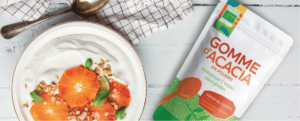
Another example of innovation with acacia gum is the recent launch of organic acacia gum as a cooking ingredient. For the first time, Alland & Robert decided to provides its expertise to consumers and launched powdered organic acacia gum packaged in a doypack, and available online via French marketplaces.
Cooking with acacia gum is now possible
Anne-Sophie Alland, Head of strategy & development at Alland & Robert, commented : “Acacia gum is a real asset for cooks looking for healthy recipes. It is an extraordinary, multifunctional ingredient, but still little known in many countries. Its functional properties are so numerous that it is useful in a multitude of recipes, whether in pastry, baking, in sauces or soups. It is Alland & Robert’s unique expertise that allows us to share these diverse applications of acacia gum. Since 1884, Alland & Robert is an expert of this product and manufactures it for the food, pharmaceutical and cosmetic industries. around the world. Our investments in Research and Development on acacia gum are very important and allow us to have unparalleled technical expertise. Our research focuses on health topics such as sugar reduction, digestive health or formulating vegetarian products.”
Acacia gum is a cooking ingredient already well known in many countries such as India and the Middle East. Violaine Fauvarque, Marketing & Communication Manager at Alland & Robert, added: “Two years of pandemic have prompted consumers to cook more at home, and to take an interest to new ingredients to diversify their recipes. At the same time, people are scrutinizing more and more the content of their plates and looking for naturalness. Acacia gum meets these requirements because it comes directly from a tree and is minimally processed. It is a plant-based and natural ingredient that is easy to use to improve a recipe. In addition, it makes it easy to achieve vegetarian or vegan recipes, all this while providing fiber enrichment !”
Alland & Robert, a company committed to the Sahel and local communties
Today, Alland & Robert exports to over 70 countries through a network of 40 distributors and is the worldwide expert of acacia gum. With the aim of providing high-quality natural gums, Alland & Robert is fully committed to sustainable growth in line with its active corporate social responsibility plan, through the manufacturing of low carbon products and the company Corporate Foundation. This vision is supported by a large network of raw material suppliers in Africa, compliance with international certifications, a dedicated R&D team and partnerships with internationally recognized universities including Montpellier University. Committed for several years to local communities in the Sahel as well as to the development of a sustainable industry, Alland & Robert created in 2021 a corporate foundation in order to strengthen its commitments in Africa, and particularly in countries where natural gums are harvested. The objective of this corporate foundation: to create a positive impact through the organization, the support and the financing of local and concrete projects. The efforts are concentrated around two axes: supporting local communities of the Sahel through various projects related to education, health, infrastructure, women’s empowerment; and the preservation of the environment and biodiversity, by leading initiatives to protect African nature, and fight against desertification and climate change. In particular, Alland & Robert is committed, through a partnership with UK NGO Tree Aid, to the “Great Green Wall”, an African initiative whose objective is to replant trees over an 8,000 km long strip in the sub-Saharan zone to stop the desert.

www.allandrobert.com


