
Colour integrity from tomato science key to expanding plant-based meat’s growing consumer appeal
Lycopene colour ingredients offer colour integrity and stability
Consumption of all plant-based foods is growing, including an exciting class of foods engineered to look and taste like beef, poultry ham and fish in popular formats like burgers, filets, and deli slices. According to Fortune Global Insights, the global meat substitutes market is projected to grow at a robust compound annual growth rate of 10.48%, from $5.37 billion in 2021 to $10.80 billion by 2028.
Plant-based meats are becoming an increasingly popular and simple way to access vegetable protein—without animals having to eat it first. As part of these new dietary trends, people are increasingly searching for alternatives to traditional diets, such as the growing number of ‘flexitarian’ consumers and meat reducers.
Market analysts FMCG Gurus recognize similar trends. A recent global study found that 34% of global consumers follow meat avoidance or other limited diets. Of these consumers, 22% revealed they chose to give up meat in the last 12 months and another 39% were considering doing so. According to FMCG Gurus, the top five reasons consumers are switching include (see below):

To bring more people to the segment, food engineers have been busy perfecting recipes that mirror the qualities of meats in common formats. Flavor and texture are extremely important to get right. But how can brands make plant-based meats more appealing and successful with consumers? One vital answer is colour integrity. Of the consumers responding to the FMCG Gurus study, 61% responded colour and appearance are important. Another 58% found it increases flavor expectations as well.[1]
Given people’s relationship with the red, orange, and pink hues associated with raw and cooked meat, the studies suggest that if plant-based meats are to taste like the real thing they must look like the real thing too. It is a straight- forward strategy: Make products attractive enough that any experience with a plant-based meat product offers a great first impression and leaves a pleasant taste in consumers’ minds.
Colouring plant-based proteins
Plant proteins, fibers and other building blocks for plant-based meats come from a variety of sources, but commercially the industry is currently engineering foods out of a variety of plant sources:
- Soy protein
- Pea protein
- Mycoprotein
- Chickpea protein
- Seaweed protein
- Cell-based cultures
Limited colour ingredients narrowing industry’s options
From an economic and technical standpoint food engineers have five primary choices for red shades to naturally colour foods created with plant proteins:
- Lycopene
- Iron oxide
- Betalains (such as red beet)
- Anthocyanins (such as black carrot)
- Carmine
Viable choices narrow when there is a requirement for vegan-friendly sources.
Carmine, although naturally derived, is made from insects which makes the ingredient unacceptable for the category.
Viable colour ingredient choices narrow fast in plant-based foods
Colouring plant-based foods is challenging because viable ingredients able to clear challenging processing hurdles are limited. Industrial-scale processing of these foods includes partly novel processes that require technical sophistication and experience establishing and stabilizing colour based on source and product conditions e.g., pH range, high pressure, shearing, interactions with the product matrix.
It is in this kind of vegan processing territory where viable colour ingredient choices, especially in the red and pink hues, narrow fast. Fortunately for developers, Lycored supplies a portfolio of lycopene-based colours for commercial application.
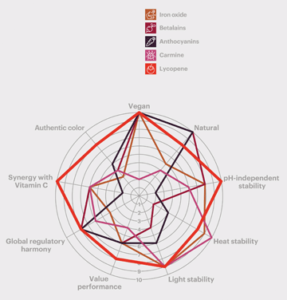
Derived from purpose-bred, sustainably sourced tomatoes, the colour ingredients from Lycored offer superior colour integrity and red hue stability with few manufacturing or performance compromises. To explore how lycopene ingredients perform, Lycored evaluated lycopene across nine performance and specifying criteria. The spider diagram shows how lycopene offers broader utility and value from a food manufacturing and marketing standpoint.
Of the five primary sources, Lycored colourants provided the pH balance, all-natural colour and taste neutrality developers need to colour and process plant-based foods.
Real-world test confirms colour integrity
Similar in-house studies found that the company’s range of super-stable colours out- performed other naturally derived colour ingredients in plant-based meat alternatives.
Focusing on plant-based deli ham slices, sausage-style encased meats and burgers, Lycored’s scientists put lycopene-based colours to the test, comparing them to the other colour alternatives. Results revealed that Lycored’s colours are ready for the rigors of plant-based food processing as well as meeting consumers’ demands for an authentic look and taste.[2]
Highlights of Lycored’s studies demonstrated:
- For ham slices and sausages lycopene colourants provided stellar performances relative to stability and authentic hues throughout both process and shelf life
- When using the ∆E method of measurement, where ∆E>4 indicates a visible difference, all lycopene-based colours performed well below this threshold in real-time and accelerated shelf-life tests in ham slices
- Lycopene-based colours in sausages maintained authentic hues before and after cooking
- In burgers, Lycored’s ResoluteRuby A helped maintain the true to beef pink shade on the inside and browning on the outside when cooked
A better colour ingredient choice for plant-based meats
Lycopene-based colours are a natural first choice for many of today’s most popular meat substitutes. Plant-based meat alternatives are vying for the top of the vegetarian product food chain, but they will not get there unless ingredients are consumer and label friendly, able to withstand intensive processing and assure colours stay true. Lycored study data confirms lycopene-based colour ingredients have the process and colour stability the industry needs to engineer success into their products.
References:
1 https://www.fortunebusinessinsights.com/industry-reports/meat-substitutes-market-100239
2 https://www.vitafoods.eu.com/content/dam/Informa/vitafoodsasia/en/2019/ education-programme-presentations/protein-innovation/1_Wednesday_ Mike_Hughes.pdf
3 https://just-food.nridigital.com/just-food_jun20/lycored

www.lycored.com and https://www.lycored.com/natural-colorants-for-food/plant-based-meats/