I spy with my little eye…
How astaxanthin can boost vision and overall eye health in an age where screens dominate lives, both professionally and socially
Astaxanthin is one of those rare nutrients that can cross the blood-retina barrier in the human body. It accumulates in the front of the eye and provides all-round protection: from ciliary muscle support and recovery, to reducing inflammation and improving capillary blood flow. Astaxanthin is a natural carotenoid derived from the microalgae Haematococcus pluvialis. Thanks to its unique molecular structure, it is the strongest known antioxidant. In addition, there are numerous scientific studies backing its clinical effects in humans.
…something green
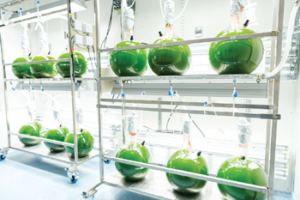
Naturally green, the algae turn red under harsh conditions such as limited nutrient supply and after exposure to UV radiation. The algae starts to produce the red pigment astaxanthin as a survival mechanism to avoid harmful oxidative stress and potential death. This powerful and efficient process can be harnessed to create competitive products that support human health and well-being. Natural astaxanthin is able to span the hydrophilic and hydrophobic layers of cell membranes, thus quenching free radicals and protecting the interior and exterior of the cells from oxidative stress and inflammation. The micronutrient also appears to play a strategic role in supporting muscles such as the ciliary body – which controls the contraction and relaxation of the lens – allowing the eye to work and recover more efficiently. Research indicates that much of astaxanthin’s muscle power is linked to mito-?chondrial protection. As lab studies have shown, astaxanthin helps to promote regeneration of mitochondria within the cells and increase their efficiency, thus improving their overall energy. But perhaps most importantly, astaxanthin offers antioxidant protection for the mitochondrial membrane by neutralizing the reactive oxygen species produced by the electron transport chain. No other antioxidant seems to have the structure or length required to span membranes as effectively. As a result, mitochondria can keep powering muscles — including the busy ciliary muscles — all day long.
…something feathery
In nature, there are numerous examples of how astaxanthin seems to naturally accumulate in the eyes. The survival of many birds depends on their sharp vision in tough environments, especially from a distance. Those known to consume large amounts of fish and marine organisms rich in astaxanthin have redness in their eyes due to hyper accumulation of astaxanthin. Researchers therefore believe that astaxanthin provides superior eye protection against free radicals generated by UV radiation, and so helps to maintain excellent vision. In addition, astaxanthin is thought to maintain the speed at which a bird’s ciliary muscles refocus as it hunts for prey. For human vision, retinal blood flow is essential in supporting the eye’s internal balance, as low blood antioxidant capacity and blood fluidity can disturb capillary circulation in the eye. Here, natural astaxanthin can help. Many clinical trials have shown that it can improve blood capillary circulation, with one study suggesting that 4 weeks of supplementation can help maintain this important function. The micronutrient was able to support retinal blood flow by preventing oxidants from degrading the nitric oxide involved in vasodilation. As a result, astaxanthin helps to provide nutrients to the eye and remove waste, and so helps combat the development of ocular diseases[1]. A second clinical study involving 36 volunteers showed that 6 mg of AstaReal® astaxanthin, taken daily, had the same positive impact on retinal capillary blood flow after 4 weeks[2].
© AstaReal AB
… something square
The time spent in front of digital devices has increased dramatically in recent years. Smartphones, online shopping and events, home working and gaming have all contributed to us spending an ever-increasing number of hours looking at screens. This has resulted in hightened exposure to blue light and its associated risks. Research indicates that overexposure to light in the 380–500 nm range disrupts sleep cycles, and possibly contributes to insulin resistance and hypertension. A double blind, placebo-controlled clinical trial investigated the efficacy of natural astaxanthin on the eye[3]. The study involved 42 computer workers who spent a minimum of 6 hours a day in front of their screens, and who struggled with eye strain and fatigue. After taking AstaReal® natural astaxanthin daily, they reported noticeable relief. Within 4 weeks, the astaxanthin group noted a decrease in symptoms such as eye strain, as well as flickering and hazy vision. Objective evaluation also showed that the astaxanthin group improved the speed at which their eyes could adjust their focus: 62% of those taking AstaReal® astaxanthin said they felt less eye strain compared with only 15% of the placebo group.

© Istock_Jun
… something promising
In addition to the many other measures we can take to protect our eyes long-term, such as wearing sunglasses on bright days, maintaining normal blood pressure and eating a balanced diet, supplementation with products containing astaxanthin can support vision. A study conducted at the Kajita Eye Clinic in Tokyo revealed that AstaReal® astaxanthin can significantly improve the ability of elderly people to focus on nearby objects[4]. A German study from 2021 on nutrition among e-gamers revealed that they were very concerned about their health and wanted to take steps to improve it[5]. As a result, specific supplementation that targets vision and regeneration appeals to the e-gaming community, whether they play professionally or for fun. There is also the opportunity to connect eye health and brain health, a pairing which is backed by science. Astaxanthin is able to cross both the blood-retina barrier and the blood-brain barrier. Clinical studies have shown that supplementation with natural AstaReal® astaxanthin contributes to better concentration, memory and mental agility. It therefore stands to reason that the growing number of e-athletes could benefit from astaxanthin supplementation, as computer strategy gamers need not only excellent vision for fast reactions, but also a high degree of mental clarity. Overall, consumers are fond of hybrid products that blend certain ingredients. Astaxanthin is a perfect fit, as it can be easily combined with a range of other ingredients. For example, it forms an ideal partnership for comprehensive eye support with the macula-protecting carotenoids lutein and zeaxanthin. Carotenoids often compete for absorption in the digestive system, but this is not the case with astaxanthin, lutein and zeaxanthin. These nutrients do not interfere with each other’s bioavailability and, instead, complement each other perfectly. Mimicking its natural presence in krill oil, astaxanthin partners beautifully with omega-3 too.
… something blue
Blue light also generates considerable oxidative stress within the eye and reduces contrast, which means eyes have to continually refocus. Accommodation is defined as the ability of the eye to change its focus from distant to near objects and vice versa. A human eye can change focus from distance infinity to 7 cm in 350 milliseconds. The circular ciliary muscles inside the eyes contract to focus on near subjects and relax to focus on distant subjects. During a long computer session, the eyes use substantial energy to focus on the screen. This overworks the ciliary muscles that help our eyes adjust to viewing at different distances, and results in eye strain and fatigue known as Computer Vision Syndrome (CVS). Thus, vision becomes temporarily blurred after a long computer session and gets worse with age. The eye lens becomes increasingly rigid, making it even harder for the ciliary muscle to adjust vision for near focus. A large body of research has shown that natural astaxanthin supplementation can improve symptoms linked to CVS, such as eye fatigue and blurred vision, by improving accommodation responsiveness, range and resilience.
… something promising
In addition to the many other measures we can take to protect our eyes long-term, such as wearing sunglasses on bright days, maintaining normal blood pressure and eating a balanced diet, supplementation with products containing astaxanthin can support vision. A study conducted at the Kajita Eye Clinic in Tokyo revealed that AstaReal® astaxanthin can significantly improve the ability of elderly people to focus on nearby objects[4]. A German study from 2021 on nutrition among e-gamers revealed that they were very concerned about their health and wanted to take steps to improve it[5]. As a result, specific supplementation that targets vision and regeneration appeals to the e-gaming community, whether they play professionally or for fun. There is also the opportunity to connect eye health and brain health, a pairing which is backed by science. Astaxanthin is able to cross both the blood-retina barrier and the blood-brain barrier. Clinical studies have shown that supplementation with natural AstaReal® astaxanthin contributes to better concentration, memory and mental agility. It therefore stands to reason that the growing number of e-athletes could benefit from astaxanthin supplementation, as computer strategy gamers need not only excellent vision for fast reactions, but also a high degree of mental clarity. Overall, consumers are fond of hybrid products that blend certain ingredients. Astaxanthin is a perfect fit, as it can be easily combined with a range of other ingredients. For example, it forms an ideal partnership for comprehensive eye support with the macula-protecting carotenoids lutein and zeaxanthin. Carotenoids often compete for absorption in the digestive system, but this is not the case with astaxanthin, lutein and zeaxanthin. These nutrients do not interfere with each other’s bioavailability and, instead, complement each other perfectly. Mimicking its natural presence in krill oil, astaxanthin partners beautifully with omega-3 too.
…something moving
Demand for products that promote eye health, along with those which contain algae and microalgae, is ever-increasing. Consumers are looking for preventative, natural ingredients to support their health. Globally, the Haematococcus pluvialis market is expected to reach a CAGR of 13.6% between 2020 and 2027, which is attributed largely to astaxanthin’s numerous health benefits, rising health awareness and increasing consumption of antioxidants in food and supplements. The European market is expected to reach nearly 30 million USD by 2027, up from 12.4 million USD in 2020, with countries such as Germany, the UK and Italy being the major contributors to this growth[6]. A Market Research Future report predicts that the eye care supplement market will grow at a CAGR of 6.36% until 2025, with the eye health supplements market valuation expected to rise to USD 9,355.09 million[7].

© Istock_fizkes
…something new
Peter Ahlm, from Asta real AB in Sweden, says: “We are keen on developing new product concepts which combine and showcase nutrients for eye health. We are flexible when it comes to dosage formats, and embrace trends such as chewable gummies. Astaxanthin as a nutrient helps dietary supplement brands meet the growing consumer desire for safe and effective eye care solutions.”
… something sustainable
Natural astaxanthin fulfils the demand for more naturally and sustainably sourced products. Microalgae-derived astaxanthin is close to the bottom of the marine food chain and thus presents a vegan and sustainable solution. At AstaReal, pioneers in astaxanthin research and distribution, the seedlings of the microalgae were originally collected from the Stockholm archipelago in a small number of test tubes without impacting natural habitats. A critical resource for production is electricity, as Haematococcus pluvialis is grown indoors for stability and purity, and relies on artificial light. AstaReal is working on reducing electricity per amount of produced material and uses only electricity generated from 100% renewable resources. The life-cycle carbon footprint of the electricity production system is fully climate- compensated. Nevertheless, production creates excess heat. AstaReal is therefore about to kick off a cooperation with an energy company, so the heat will be fed into the local district heating grid of Gustavsberg, Sweden. This, in turn, will decrease the external energy needed to heat up dormitory buildings. Another challenge AstaReal has taken on is finding packaging solutions that are sustainable and protect against oxygen penetration.
…quality
When choosing an astaxanthin supplier, companies should pay particular attention to their production methods, the stability and purity of their products, the astaxanthin content in the biomass and their quality certifications, as the nutrient’s quality is affected by the environment in which Haematococcus pluvialis is cultivated. AstaReal rejects outdoor production methods as those are susceptible to contamination. Controlled conditions lead to a safe, stable product with at least 5% astaxanthin content in the biomass and no impurities.
References:
1 Saito M, Yoshida K, Saito W, Fujiya A, Ohgami K, Kitaichi N, et al. Astaxanthin increases choroidal blood flow velocity. Graefes Arch Clin Exp Ophthalmol. 2012 Feb;250(2):239–45.
2 Nagaki Y, Mihara M, Takahashi J, Kitamura A, Horita Y, Sugiura Y, et al. The effect of astaxanthin on retinal capillary blood flow in normal volunteers. Journal of Clinical Therapeutics and Medicines. 2005;21(5):537–42.
3 Nagaki Y, Mihara M, Tsukuhara H, Ohno S. The supplementation effect of astaxanthin on accommodation and asthenopia. Journal of Clinical Therapeutics and Medicines. 2006;22(1):41–54.
4 Kajita M, Tsukahara H, Kato M. The Effects of a Dietary Supplement Containing Astaxanthin on the Accommodation Function of the Eye in Middle-aged and Older People. Medical consultation & new remedies. 2009;46(3):89–93.
5 Froböse I, Rudolf K, Bickmann P, Tholl C, Soffner M, Wechsler K, et al. eSport Studie 2021. Ernährung im eSport – Mehr als nur Pizza und Energydrinks (?). Institut für Bewegungstherapie und bewegungorientierte Prävention und Rehabilitation. 2021.
6 Meticulous Research. Haematococcus Pluvialis Market – Global Opportunity Analysis and Industry Forecast (2020-2027). 2021.
7 Market Research Future. Eye Care Supplements Market Overview. In: Eye Care Supplements Market Information: By Type (Antioxidant, Fatty Acids, Anti-Inflammatory), Application (Eye Health, Macular Degeneration, Cataract, Glaucoma, Diabetic Retinopathy), End User (Eye Hospitals, Eye Clinics) – Global Forecast till 2027. 2022.

www.astareal.se