Fake Mineral Salts – Great Find or Great Fraud?
Mass media is threatened by “fake news“, but there is also another topic arising in the food industry to worry about: “fake Minerals”. This is a form of food fraud and more specially: “ingredient fraud”, which is essentially the fraudulent replacement of an original (more expensive) raw material with a less expensive one, without the purchaser’s knowledge, for economic profits or competitiveness in the market. Adulteration and fraudulence of ingredients are global concerns for stakeholders, industries, risk assessors and consumers. The issue of food fraudulence is a current world-wide concern. There has been a massive increase in the number of cases that range from horsemeat in lasagne to melamine in infant formula. Less well known, is the fact that individual ingredients in foods or dietary supplements, that claim to be in the product for beneficial health reasons, can also be “faked”. In the world of food fraud, Mineral Salt adulteration is one act of defrauding buyers, product developers and in the end consumers for economic gain. Mainly organic Mineral Salts such as Citrates, Lactates, Gluconates, Bisglycinates and many more are adulterated and in focus to be replaced by using all kinds of substances – mainly cheap and inactive. Instead of using fully reacted pure Mineral Salts, food or food supplement producers end up in processing unreacted compounds of inorganic substances such as Oxides, Carbonates or others. This can lead to uncontrolled impurity profiles, formulation stability problems or misbranded and finally adulterated products without the positive effect of fully reacted Mineral Salts like a good bioavailability and less side effects. Fully reacted Mineral Salts have genuine health benefits. The practice of substituting fully reacted organic Mineral Salts with unreacted blends has the potential to prevent individuals consuming these products for health reasons and from receiving the benefits they are in fact seeking. Fraudulent products that have been adulterated from their pure form will not show the same functionality in the body and would not show the same positive attributes as evidenced in scientific studies. Meanwhile, unknown reactions in the body may take place. The body is used as reaction vessel as the reaction of e.g. Magnesium Carbonate in combination with citric acid leads to the formation of Magnesium Citrate in the stomach. The absorption of valuable components might be strongly reduced. Any product subject to adulteration does not meet health requirements beneficial to customers and certainly will not withstand the standards of the manufacturer distributing final products. Moreover, uncontrolled impurity profiles due to raw materials that are contaminated with e.g. heavy metals might occur. In the case of chemically synthetically manufactured products that are fully reacted, purification processes are used to remove any undesirable substances.
Fully reacted Mineral Salts
√ high purity
√ genuine health benefits
√ high bioavailability
√ less side effects Fake Mineral Salts
√ uncontrolled impurity profiles
√ low absorption
√ formulation stability problems
√ misbranded and adulterated final products
Regulatory status
The regulation of Mineral Salts for the use in food supplements is one of the most complex topics in food law. In Europe, in the United States as well as in Asia compliance with food law provisions is monitored by competent supervisory authorities. Although final products must be registered with local authorities, they are only checked at random. The manufacturers are responsible for the safety and the correct declaration of their products; but the lack of published monographs of many widely used Mineral Salts leaves buyers, product developers and quality departments wondering if the products they buy are indeed safe. These unreliable practices continue to create uncertainty about the chemical manufacturing process, and too many doubting if the desired product is in fact a fully reacted organic Mineral Salt.
Process of manufacturing
High purity fully reacted organic Mineral Salts are known to be highly bioavailable for the human body. They are typically manufactured by a chemical reaction, wherein an acid and an alkaline Mineral source react in an aqueous solution. The result of a complete reaction is the formation of a Salt compound that is highly pure and fully reacted. This process is a so-called neutralization reaction, where a strong acid and a strong base counteract each other and a neutral solution with a pH-value of 7 is obtained. This is why most fully reacted Mineral Salts have a fairly neutral pH-value. This, on the other hand, stands in contrast to a dry blend of ingredients that show an acidic or alkaline pH-value. (see table 1)

The possibility of purification within the production process as well as clearly defined structures for the final organic salt can only be ensured by using sophisticated manufacturing processes. In this case the purification process includes the elimination of impurities like heavy metals, residues from mining, foreign matter and others. For each element individual impurities are characteristic: Magnesium is typically accompanied by nickel, whereas Zinc occurs with lead and cadmium. Furthermore, Iron Salts are often accompanied by various heavy metals and a purification step is crucial.
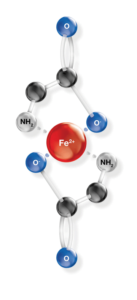
Examples and deficiencies of Mineral Salt “Fakes”
A fully reacted Trimagnesium Dicitrate for example shows an almost neutral pH-value. A simple way to demonstrate the presence of unreacted mineral base is the addition of acid. A product blended with Carbonate or Oxide, will create an effervescence reaction. Many Oxides contain Carbonate residues by nature. These alkaline ingredients for example can react with any acidic ingredients and produce CO2. The unreacted blend can cause additional uncontrollable and unforeseeable reactions. A blend of unreacted salts might be unstable due to slow but ongoing reactions in the formula of the final product. This reaction can also result in hardened powder formulas or popped/burst blister packs with tablets that are disintegrated. Those alkaline substances can also react with other substances in the formulation, e.g. vitamin C or cause unforeseeable exothermic reactions. Decomposed mixtures could even comprise hazardous, corrosive substances. In liquid applications, like beverages, an adulterated/blended product might not show the solubility of a fully reacted Mineral Salt. It might dissolve in an inappropriate time or even become sedimentary, thereby damaging the integrity of the final product being sold and consumed. Formulations that contain blends of mineral ingredients may have inappropriate or misleading ingredient labelling. In the case of Trimagnesium Dicitrate, one should become conscientious when purchasing a product with a content of 20% Magnesium. Due to the stoichiometry of a fully reacted Magnesium Citrate it can only offer a maximum of 16% Magnesium in the anhydrous form. Even with the best drying capabilities, a higher Magnesium content cannot be achieved. Therefore, products claiming a higher mineral content are blends and should be labelled in the ingredients lists accordingly e.g. Magnesium Citrate and Magnesium Oxide/Magnesium Carbonate. Another example is a “chelated taste free Iron Salt”, which sounds like the perfect solution for any application where taste and bioavailability are required. Unfortunately, this is not possible. Chelated Mineral Salts are fully reacted complex molecules. In the case of Bisglycinates they are Salts of the endogenous amino acid glycine. They bind the glycine directly through a highly sophisticated chemical manufacturing process in the presence of citric acid until they are fully reacted: meaning that a bonding has been formed in the complex between the mineral ion and its ligands. The chelate structure has a positive effect on the solubility, which improves the bioavailability of this organic compound.[1,2] Moreover, the amino acid chelate is only digested in the intestine, which optimizes the absorption.[3] Most chelated Minerals have a strong (often negative) taste impression. In case of chelated Iron they even leave a metallic taste in the mouth. It is apparent that products claiming to be tasteless like a “taste free Iron Bisglycinate” are blends of unreactive salts. When taking a closer look to those products one can recognize that, a reddish material, which shows high magnetic properties, cannot be a fully reacted Ferrous Bisglycinate with a typically greenish-brown colour and without any magnetic characteristics. This would rather be a blend of Iron(III) Oxide and Iron powder and the amino acid glycine. Analysis is tricky in this case because it is possible to find Fe(II) when doing a wet-chemical analysis even though the ingredients of the blend are entirely unreactive. Another example could be Magnesium Taurinate that has been used rather rarely so far. It is permitted for the use in food supplements in Europe.[4] It features a bioavailable source of Magnesium combined with the natural body constituent taurate, which most customers know as core ingredient in “energy drinks” (taurine, a naturally occurring beta-amino acid). However, there are products on the market which are only dry blends of Magnesium Oxide and taurine. Apart from the fact that the alleged fully reacted material is not soluble a more detailed examination, for example with a complementing combination of two methods like an elemental and structural analysis (by using XRD and EDX on the electron microscope), can be used to identify the material. In the qualitative analysis of the surface of solid or powdery materials, the Energy Dispersive spectroscopy by X-rays (EDX) is used to identify the elements. In SEM (Scanning Electron Microscope) pictures a heterogeneous structure provides the first hint on an unreacted compound. The SEM picture (see fig.2) of the fake Mineral shows smooth, large taurine crystals and then the small, composite Magnesium Oxide particles. The fake taurinate does not have a uniform crystal structure, which also affects its physical properties such as solubility. The taurine can go into solution, while the Magnesium Oxide remains undissolved. A fully reacted Magnesium Taurinate in turn would show a homogeneous structure due to the wet-chemical production process that is necessary. Furthermore, the X-Ray Diffraction (XRD) gives information on the identity of a crystalline substance. Compared with the X-ray diffractograms of single ingredients one will see if the material is a compound of pure taurine and e.g. Magnesium oxide or a fully reacted Magnesium Taurinate. There are several other ways to differentiate between a fully reacted Mineral Salt and a blend of reactants or fraudulent Mineral Salts. Precise analytical detection methods like chemo metric data analysis as well as simple sensory evaluations, electron microscopy for crystal structure analysis, thermogravimetric analysis or even x-ray diffraction can help to detect fraudulent Mineral Salts.
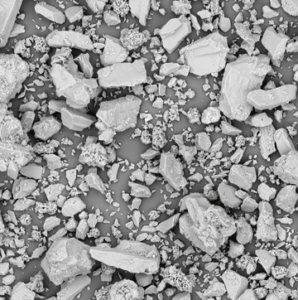
Further detection methods
A simple and very revealing method for identification, characterization and structure elucidation is the InfraRed spectroscopy. To differentiate between a fully reacted Mineral Salt and a blend of reactants infrared rays (wavelength approx. 800nm-1mm) are inserted into the material to be tested and individual molecules are made to vibrate. Some wavelengths are absorbed by the material; this in turn is imaged as absorption bands. The infrared spectrum is, like a molecular “fingerprint”, characteristic for the investigated molecule. This method can ensure that fully reacted Mineral Salts have the correct molecular structure. NMR (nuclear magnetic resonance) spectro-scopy is a very powerful method for the analysis and identification of substances, as well as for the structural characterization of mostly organic compounds. It is based on the different behaviour of magnetically active atomic nuclei under the influence of an external strong magnetic field. NMR spectroscopy is used, for example, to ensure that the compound shown is in fact the substance of interest. NMR spectroscopy maps the “fingerprint” of a molecule. The NMR profile of Lysine HCI in comparison to Magnesium Bislysinate HCI show a shift of approx. 6 ppm the first C atom from 175 ppm for the free amino acid Lysine HCI to 181 ppm for the fully reacted Magesium Bislysinate. The same observation can be made for the comparison of Glycine vs. Magnesium Bisglycinate. The shift is from 179 ppm for the free amino acid Glycine to 173 ppm for the fully reacted Magnesium Bisglycinate. In both cases the second C atom remains unaffected.
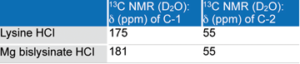
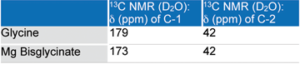
Comparable products
Meticulous inspection of labels and packaging is another way to uncover fraud. If anything seems to be unclear or misleading, food business owners should ask questions and if there are no reassurances, they should not purchase the ingredients. Legitimate Mineral Salts that are permitted for the use in food or dietary supplements, will have been approved by local authorities based on extensive studies, including proof of bioavailability and toxicological characteristics. In Europe e.g. the EFSA (European Food Safety Authority) carries out safety assessments to evaluate the safety of a raw material for consumers. The Mineral Salts are usually clearly defined by relevant quality descriptions such as pharmacopoeias or E-Numbers. These parameters should be found in the manufacturers’ product specifications (often parameters such as “identity”, “assay”, “pH” are listed among others): the parameters listed in the specifications should have been analysed accordingly for each production batch. Anything out of the normal range should be suspicious. Still in some cases, if the parameters “identity” or “assay” fit to the desired material, experts find it hard to examine whether it is a fake or not – the best way to proof if it is indeed a fully reacted organic Mineral Salt would depend on the analytical methods used (as described above). Very helpful can be the comparison of a product with a reliable product that is already sold on the market.
Price
All buyers along the food chain should also be conscientious when purchasing ingredients and may be right to be suspicious if they are offered a product that is well below the normal cost price. Even if they were quite sure about the selection of their current suppliers they should not hesitate to critically and systematically question the legitimacy of products being sold to them. The buyer, should refrain from buying inferior or blended goods for a fixed price, in order to procure products as cheaply as possible.
Combating mineral salt adulteration
While there are public databases compiling reports for food fraud, there is no tool for ingredients like Mineral Salts. Producers of food supplements should use good judgment when purchasing their raw materials. Unfortunately, there are no educational resources available and no guidance for industry to support the quality assurance and safety of these products. The detection of food fraud is not easy, especially in the case of Mineral Salt adulteration. So what tools can deter fraudsters, or give early detection of fraudulent salts?
Partnership with specialized producers having established food standards
In order to maintain the integrity of a product, one should rely on partnerships with raw material manufacturers instead of pure trading activities. Producers with extensive specialized knowledge that process raw materials of trustworthy resources with the strategy to communicate openly and transparently about the production will distinguish themselves from the fraudsters in the industry. Since the so-called Benchmarking Requirements of the GFSI (Global Food Safety Initiative) published in 2017 – there are clear requirements against food fraud which have to be included in all GFSI-approved food safety standards.[5,6] This applies to the IFS standards as well as BRC or FSSC 22000, a system used by food manufacturers to prevent food fraud. Oversight, information, and communication are essential to a productive and beneficial system to eliminate food fraud. The central element being a hazard analysis and risk assessment implementation.
Great Find or Great Fraud?
While existing product fraud initiatives have focused on food, food supplements and drugs in general, little attention has been devoted to defining the new, complex and interdisciplinary thread of ingredient fraud. The prevalence of Mineral Salts being adulterated serves as supporting evidence for the need to create for a proactive approach towards prevention and a greater focus on regulation and oversight. A comprehensive compilation of information about known problematic Mineral Salts and detection methods does not currently exist. Therefore, the problem of adulteration will continue to persist for consumers, manufacturers, retailers, and authorities. Due to globalisation and fragmentation of the flow of goods as well as creative forms of falsification and new methods of analytical proof, Mineral Salt adulteration remains an industry challenge, even as industry and consumer increasingly demand more transparency in sourcing and labelling. Unfortunately, as long as the food and food supplements industries continue to compete primarily on price points, certain companies will continue to undermine their product in order to undercut their competitors. Adulteration appears to be one approach to cutting cost for profit as it offers surprisingly cheap products and alternatives. Adulteration poses many serious and long term risks and ramifications for suppliers and consumers. If not regulated, it has the potential of overrunning legitimate resources and eventually causing health and safety issues on a global scale. Dr. Paul Lohmann® is the world’s leading manufacturer and provider of high value Mineral Salts for the food, nutritional supplement and pharmaceutical industry. Since 1886, a high level of flexibility and an innovative spirit enables Dr. Paul Lohmann® to respond to changing needs. Customers can profit from the broadest available portfolio of high value Minerals, with more than 400 products in a range of qualities, designed to provide optimum performance across a wide range of applications. In the GMP and FSSC 22000 certified facilities, Mineral Salts are produced at quality levels stipulated by pharmacopoeias, regulatory food guidelines or tailored according to customers’ specifications. Dr. Paul Lohmann® also carries out product and application development in close cooperation with customers. This includes the adaptation of chemical and physical parameters such as bulk density, wettability, particle size, purity or pH-value.
References:
1 Ferrari, P., Nicolini, A., Manca, M. L., Rossi, G., Anselmi, L., Conte, M., … & Bonino, F. (2012). Treatment of mild non-chemotherapy-induced iron deficiency anemia in cancer patients: comparison between oral ferrous bisglycinate chelate and ferrous sulfate. Biomedicine & Pharmacotherapy, 66(6), 414-418.
2 Name, J. J., Vasconcelos, A. R., Maluf, V. R., & Cristina, M. (2018). Iron Bisglycinate Chelate and Polymaltose Iron for the Treatment of Iron Deficiency Anemia: A Pilot Randomized Trial. Current pediatric reviews, 14(4), 261-268.
3 Bagna, R., Spada, E., Mazzone, R., Saracco, P., Boetti, T., Cester, E. A., … & Coscia, A. (2018). Efficacy of Supplementation with Iron Sulfate Compared to Iron Bisglycinate Chelate in Preterm Infants. Current pediatric reviews, 14(2), 123-129.
4 Directive 2002/46/EC of the European Parliament and of the Council of 10 June 2002 on the approximation of the laws of the member states relating to food supplements
5 https://mygfsi.com/press_releases/gfsi-releases-new-edition-of-benchmarking-requirements/

Dr. Paul Lohmann GmbH & Co. KGaA
Hauptstrasse 2
31860 Emmerthal/Germany