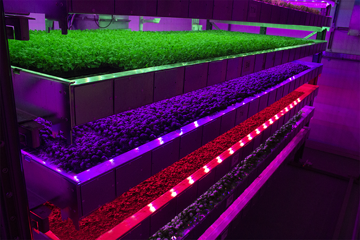
Intelligent Growth Solutions can help future-proof food production through home-grown vertical farming technology
More than 200 types of fruit and vegetables can be produced safely isolated from weather or pests
Proven technology offers 8-12 times the growing space and can produce crops six times quicker
Just 60 commercial-scale vertical farms could make the UK self-sufficient in the leafy greens currently missing from supermarket shelves.
Intelligent Growth Solutions (IGS) provides indoor vertical farming infrastructure, a home-grown technology that allows farmers to efficiently produce more than 200 different varieties of crops indoors in a pest and disease-free environment which is shielded from the weather.
More than 100 towers can be built on the same site, each offering between eight and 12 times the growing capacity of their footprint. The Edinburgh-headquartered business says their growth towers can help fix a food supply chain that is near to breaking point because of the impacts of climate change, Brexit, and war in Ukraine.
Andrew Lloyd, Chief Operations Officer at IGS, said: “It’s becoming clear that our food supply chain is broken, and the UK has hit a breaking point. Leaning into new technology and integrating vertical farming into current food production systems will make the UK more resilient to import variations, staffing problems, disease and climate or weather events.
“Not only can our technology address today’s pressing needs, but it enables our farmers to complement their business and diversify into other crops year-round.”
Professor Derek Stewart, Director of the Advanced Plant Growth Centre at The James Hutton Institute, said: “The UK has an overall £6bn deficit for fruit and vegetables, which includes £1.7bn for protected salad crops*. This could be reversed almost completely with the adoption of vertical farming which has the added bonus of being able to extend shelf-life, enhance nutritional density and the taste of crops, all whilst reducing waste.
“The combined science and technology we use means we can control the growing environment. By linking to renewable energy, this will lead to significant savings in terms of water and fertiliser use, allow greater confidence in food safety and will make a major contribution to local food security.”
OneFarm is a sustainable food producer that uses vertical farming technology at their site in Newmarket, Suffolk. Mira Merme, CEO of the company, said: “The accelerated growth times and consistently high-quality produce means that smart vertical farming growth towers can become a serious part of UK food production.
“Vertical farming technology in the right hands can readily work in tandem with traditional farming techniques to bolster output, introduce new crops and ensure a steady supply of high demand items, such as salad, herbs, chillies, kale or broccoli grown locally and available to the end consumer at affordable prices.”
Andrew added: “With retailers in the UK more inclined to buy fruit and veg on a longer-term model, and with the real impact of post-Brexit border rules for imports not known until January 2024, more needs to be done to future-proof our food production, and fast.
“On top of this, so-called once-in-a-generation weather events are becoming more common, these problems are no longer outliers. If we want future food security, we need to start taking action.”
Innovations in Food (& Beverage) Technology is a quarterly magazine distributed globally both in Print and Digital formats. www.innovationsfood.com. Twitter: @Innovfoodtech. Instagram: @innovationsinfoodtechnology. Linkedin: www.linkedin.com/in/terry-prior52